
Oregon State University, University of Alaska Fairbanks and Woods Hole Oceanographic Institution
Chukchi Sea, Arctic, Summer 2026
Study objectives
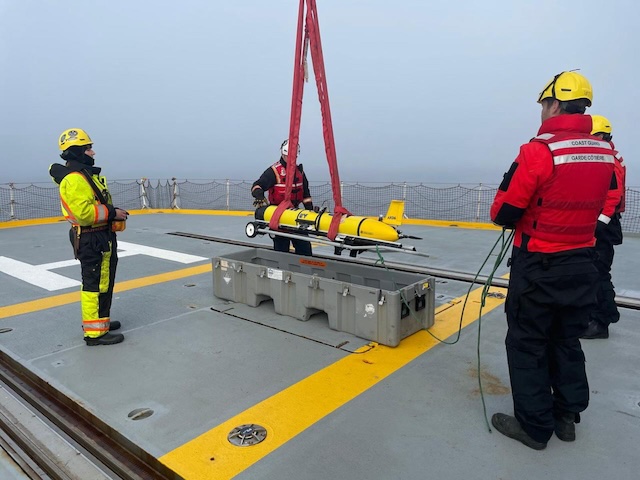
A Slocum G2 glider was deployed in the Chukchi Sea off the northwest coast of Alaska on July 24, 2026 to study the occurrence of several species of marine mammals, including fin, bowhead, and beluga whales, as well as bearded seals and walrus. This project is designed to examine relationships between marine mammal distribution and oceanographic conditions monitored by the glider. Results shown on this page have been reviewed by an experienced analyst (Kate Stafford) and represent locations and times where the near real-time passive acoustic detection data provide evidence of species occurrence.
Principal Investigators: Kate Stafford (Oregon State University), Seth Danielson (University of Alaska Fairbanks), and Mark Baumgartner (WHOI)
Analyst: Kate Stafford (Oregon State University)
Platform location:

Analyst-reviewed species occurrence maps:

Daily analyst review:
| | Detected |
| Possibly detected |
| Not detected |
Time series:

The figure above shows daily whale occurrence for sei, fin, right
and humpback whales derived from analyst-reviewed call detections.
Occurrence is measured as the percentage of 15-minute summary periods
during a single day when whale calls are detected (red; periods when
the evidence for whale presence is convincing) or possibly detected
(yellow; periods when there is evidence for whale presence, but it is not
completely convincing). A summary period is a 15-minute period over which
an analyst determines if whales are detected, possibly detected or not
detected based on the protocol described in Baumgartner et al. (2019)
and Wilder et al. (2023). Please note that these time series should not
be considered an indication of whale abundance.
Diel plot:

The figure above shows when sei, fin, right and humpback whales were
detected (red), possibly detected (yellow), or not detected (gray) for
every 15-minute summary period reviewed by the analyst. The data are arranged
by hour of day (x axis) for each day of the deployment (y axis) to allow
evaluation of day-night (i.e., diel) patterns. The white lines indicate the
local time of sunrise and sunset.
Recent background noise:

Oceanographic observations:

Links to detailed information:
Automated detection data
Analyst notes
DMON/LFDCS diagnostics
Platform diagnostics
Questions
Please email Mark Baumgartner at mbaumgartner@whoi.edu. For a general desciption of the detection system and the autonomous platforms, visit dcs.whoi.edu.
Acknowledgements
The Teledyne Webb Research Slocum underwater glider used in this study was expertly prepared by the University of Alaska (UAF) College of Fisheries and Ocean Science (CFOS) underwater glider operations team led by Hank Statscewich. This deployment was made possible by Paul Macoun (Fisheries and Ocean Sceinces Canada), chief scientist of the deployment cruise on the CCGS Sir Wilfrid Laurier. At sea assistance was provided by the captain and crew of the CCGS Sir Wilfrid Laurier. Support for the development of the Arctic marine mammal call library as well as the preparation and operation of the glider in 2026 was provided by the Alaska Ocean Observing System. The glider was procured in 2016 with support from the North Pacific Research Board.
Home