
Rutgers University and Woods Hole Oceanographic Institution
Coastal New Jersey, Winter 2025-2026
Study objectives
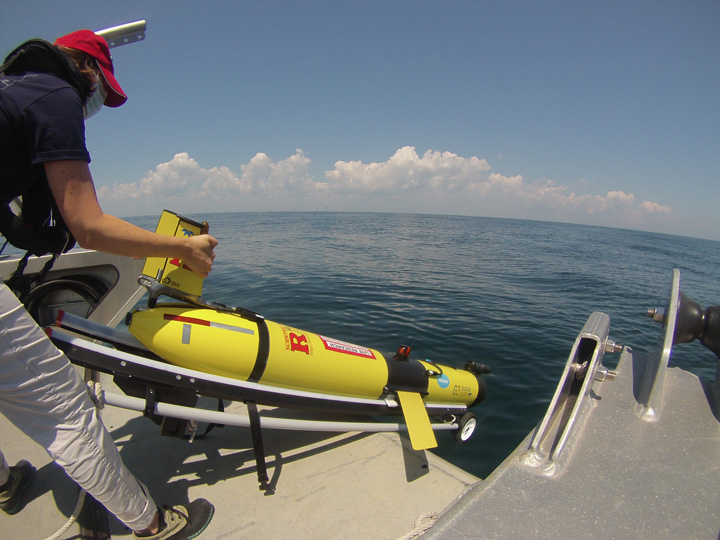
A Slocum G3 glider was deployed off the coast of Atlantic City, New Jersey to conduct surveys for tagged fish and baleen whales, including the critically endangered North Atlantic right whale.
Principal Investigators: Josh Kohut and Grace Saba (Rutgers University) and Mark Baumgartner (WHOI)
Analyst: Julianne Wilder
Platform location:

Analyst-reviewed species occurrence maps:

Daily analyst review:
| | Detected |
| Possibly detected |
| Not detected |
Time series:

The figure above shows daily whale occurrence for sei, fin, right
and humpback whales derived from analyst-reviewed call detections.
Occurrence is measured as the percentage of 15-minute summary periods
during a single day when whale calls are detected (red; periods when
the evidence for whale presence is convincing) or possibly detected
(yellow; periods when there is evidence for whale presence, but it is not
completely convincing). A summary period is a 15-minute period over which
an analyst determines if whales are detected, possibly detected or not
detected based on the protocol described in Baumgartner et al. (2019)
and Wilder et al. (2023). Please note that these time series should not
be considered an indication of whale abundance.
Diel plot:

The figure above shows when sei, fin, right and humpback whales were
detected (red), possibly detected (yellow), or not detected (gray) for
every 15-minute summary period reviewed by the analyst. The data are arranged
by hour of day (x axis) for each day of the deployment (y axis) to allow
evaluation of day-night (i.e., diel) patterns. The white lines indicate the
local time of sunrise and sunset.
VEMCO tag detections:
Recent background noise:

Oceanographic observations:

Links to detailed information:
Automated detection data
Analyst notes
VEMCO tag detection data
DMON/LFDCS diagnostics
Platform diagnostics
Sounds
What types of sounds are we monitoring? Find examples of the sounds right, fin, sei and humpback whales make here.
Questions
Please email Mark Baumgartner at mbaumgartner@whoi.edu. For a general desciption of the detection system and the autonomous platforms, visit robots4whales.whoi.edu.
Acknowledgements
The Slocum glider was prepared by David Aragon, Nicole Waite, Chip Haldeman and John Kerfoot (Rutgers University). Engineering support for the DMON2 instrument deployed on this glider was provided by Jim Partan and Keenan Ball (WHOI). Support for the preparation, deployment and operation of the glider was provided by the Research and Monitoring Initiative of the New Jersey Department of Environmental Protection.
Home

