
Dalhousie University and University of New Brunswick
Irminger Sea, July 2026
Study objectives
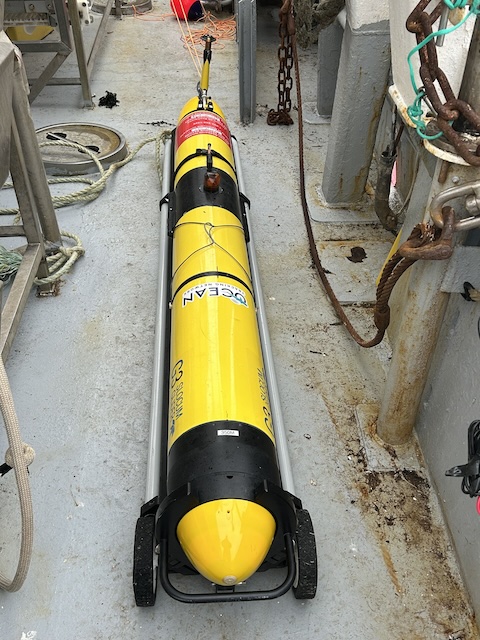
A Teledyne Webb Research Slocum G3s glider equipped with a passive acoustic listening device (DMON/LFDCS) was deployed in the Irminger Sea (North Atlantic) for a multi-month mission with a lithium primary battery pack. The purpose of this mission is to monitor for North Atlantic right whales in the historic Cape Farewell whaling grounds.
Principal Investigator: Danielle Cholewiak (NOAA NEFSC), Peter Duley (NOAA NEFSC), Marianne Rasmussen (University of Iceland) and Joe Roman (University of Vermont)
Analysts: Jazmine Allan (Ocean Tracking Network) and Kate Indeck (University of New Brunswick)
Platform location:

Analyst-reviewed species occurrence maps:

Daily analyst review:
| | Detected |
| Possibly detected |
| Not detected |
Time series:

The figure above shows daily whale occurrence for sei, fin, right
and humpback whales derived from analyst-reviewed call detections.
Occurrence is measured as the percentage of 15-minute summary periods
during a single day when whale calls are detected (red; periods when
the evidence for whale presence is convincing) or possibly detected
(yellow; periods when there is evidence for whale presence, but it is not
completely convincing). A summary period is a 15-minute period over which
an analyst determines if whales are detected, possibly detected or not
detected based on the protocol described in Baumgartner et al. (2019)
and Wilder et al. (2023). Please note that these time series should not
be considered an indication of whale abundance.
Diel plot:

The figure above shows when sei, fin, right and humpback whales were
detected (red), possibly detected (yellow), or not detected (gray) for
every 15-minute summary period reviewed by the analyst. The data are arranged
by hour of day (x axis) for each day of the deployment (y axis) to allow
evaluation of day-night (i.e., diel) patterns. The white lines indicate the
local time of sunrise and sunset.
Recent background noise:

Links to detailed information:
Automated detection data
Analyst notes
DMON/LFDCS diagnostics
Platform diagnostics
Questions
Please email Mark Baumgartner at mbaumgartner@whoi.edu. For a general desciption of the detection system and the autonomous platforms, visit robots4whales.whoi.edu.
Acknowledgements
This is a collaboration between NOAA NEFSC, the Ocean Tracking Network at Dalhousie University, University of Vermont and the University of New Brunswick. Glider preparation, piloting and acoustic analysis were overseen by Adam Comeau and his team at the Ocean Tracking Network. Special thanks to Andreas B. Heide, and Edda Elisabet Magnusdottir, Halldor Palmar Halldorsson, and Marianne Helene Rasmussen at the University of Iceland for facilitating the glider deployment.
Home